On the job market! 🔍
I'm seeking research positions in HCI, Responsible AI, and AI evaluation & auditing, in both academia and industry. Get in touch.
I build evaluation infrastructure that puts communities in control of AI: methods and tools that let the people affected by AI systems define, measure, and audit what counts as good performance.
- Infrastructure & Behavior · quantitative work using causal inference to understand how infrastructures such as broadband and LLMs shape human behavior and knowledge gaps on Wikipedia and OpenStreetMap
- Stakeholder AI Evaluation · mixed-methods work building tools that let stakeholders audit and evaluate AI in their own contexts
I publish at CHI, CSCW, FAccT, AIED, and CSCL. I'm a member of the Collaborative Computing Group (MadCollab), advised by Dr. Jacob Thebault-Spieker, and I collaborate with Dr. Shamya Karumbaiah in the Responsible AI for Learning (TRAIL) Lab. Before my PhD, I earned an M.S. in Urban Data Science from New York University.
Research interests: human-computer interaction · responsible AI · AI evaluation & auditing · computational social science · peer production
Selected Publications
add figure:
img/pubs/facct26_repair.svg
img/pubs/facct26_repair.svg
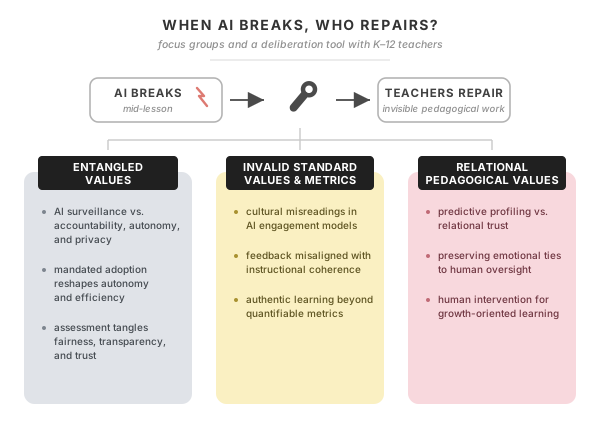
When AI Breaks, Teachers Repair: Pedagogical Repair Work in Situated Classroom Practice
ACM FAccT 2026
What happens when classroom AI breaks down? Using focus groups and a deliberation tool we developed, we document the pedagogical repair work teachers perform to keep AI-supported instruction running, and argue that this often invisible labor should reshape how educational AI is designed and evaluated.
add figure:
img/pubs/chi26_broadband.svg
img/pubs/chi26_broadband.svg
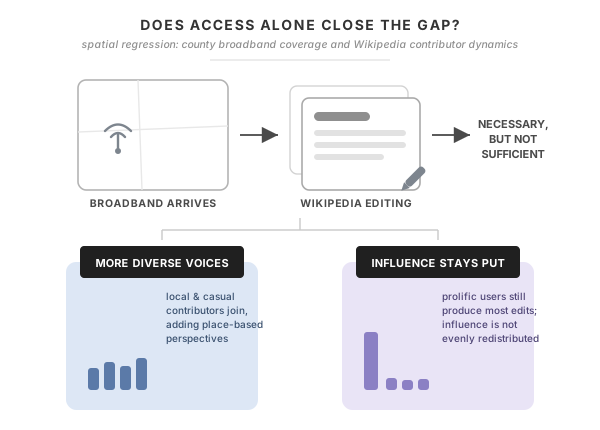
Beyond Access: Contextualizing the Benefits of Broadband through Contributor Dynamics on Wikipedia
ACM CHI 2026
Does broadband access translate into online participation? Linking broadband connectivity to contributor dynamics on Wikipedia, we show that the benefits of access are contextual, shaped by who contributes, and from where.
add figure:
img/pubs/facct25_priorities.svg
img/pubs/facct25_priorities.svg
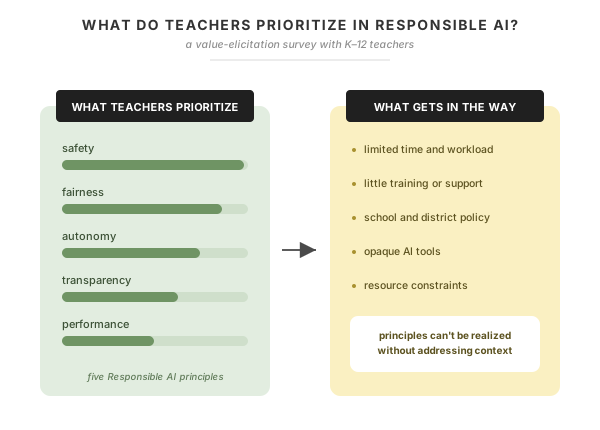
Responsible AI in Education: Understanding Teachers' Priorities and Contextual Challenges
ACM FAccT 2025
What does responsible AI mean to the teachers expected to use it? Using a value-elicitation survey approach, we examine teachers' priorities for responsible AI and the contextual challenges that determine whether those priorities can be realized in practice.
add figure:
img/pubs/aied25_aibat.svg
img/pubs/aied25_aibat.svg
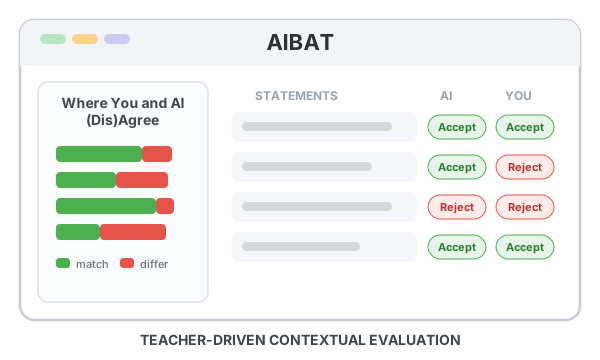
AIBAT: AI Behavior Analysis Tool for Teacher-Driven Contextual Evaluation of Language Models in Education
AIED 2025 🏅 Best Paper Nomination
Can teachers make sense of the harms and benefits of LLMs in their daily tasks? We developed AIBAT, an audit tool supporting teacher-driven, contextual evaluation of language models in education, putting the criteria for "good" AI behavior in educators' hands.
add figure:
img/pubs/cscl25_teacher.svg
img/pubs/cscl25_teacher.svg
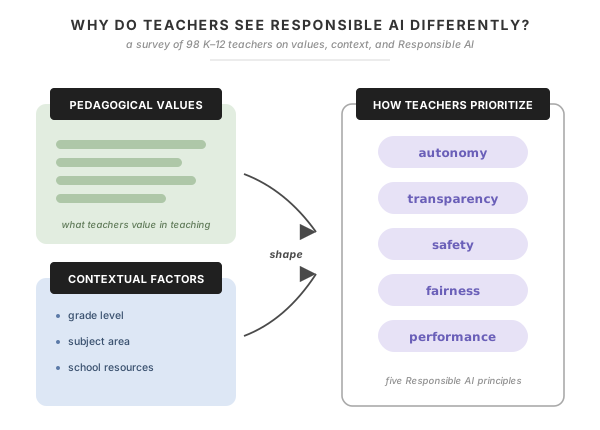
Toward Teacher-Centered AI Design: Exploring the Role of Pedagogical Values and Contextual Factors in K-12 Teachers' Perceptions of Responsible AI
CSCL 2025 🏅 Best Paper Nomination
How do pedagogical values and classroom context shape what K-12 teachers see as responsible AI? Our findings motivate teacher-centered approaches to designing AI for education.
add figure:
img/pubs/cscw25_density.svg
img/pubs/cscw25_density.svg
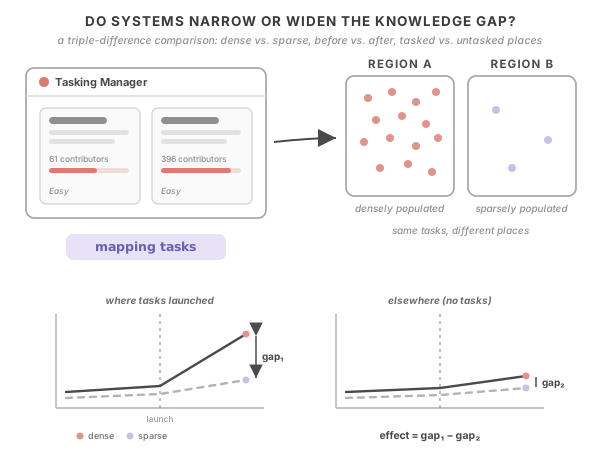
The Effect of Population Density on Remote Humanitarian Mapping Activities: A Triple-Difference Analysis
ACM CSCW 2025
Where does remote humanitarian mapping actually happen? Using a triple-difference analysis, we examine how the humanitarian OpenStreetMap platform reshapes underlying biases along population density, creating opportunity in some places while deepening gaps in others.
add figure:
img/pubs/cscw24_tradeoffs.svg
img/pubs/cscw24_tradeoffs.svg
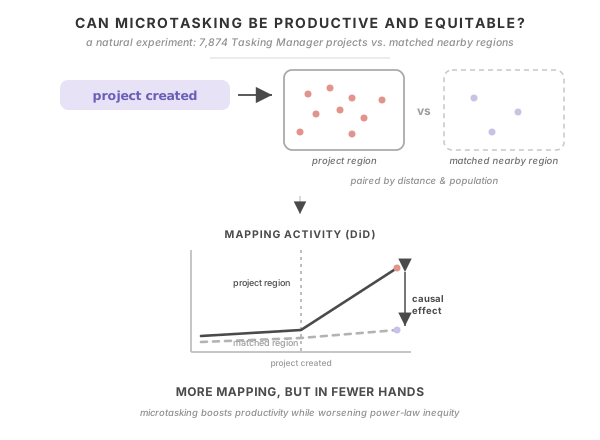
Productivity or Equality? Tradeoffs in Volunteer Microtasking in Humanitarian OpenStreetMap
ACM CSCW 2024
Microtasking makes volunteer mapping more productive, but at what cost? Using causal inference, we identify tradeoffs between productivity and equality in humanitarian OpenStreetMap, showing how task design shapes whose places get mapped.
Awards, Fellowships & Grants
- 2025Best Paper Nomination — AIBAT @ AIED 2025
- 2025Best Paper Nomination — Responsible AI in Education @ CSCL 2025
- 2025Lambda's Research Grant
- 2024UniverCity Alliance Scholars
- 2024Graduate Fellow, The Institute for Diversity Science, UW–Madison
- 2022Fellow Researcher, Center for Advancing Safety of Machine Intelligence, Northwestern University
- 2022Google Computer Science Research Mentorship, Google